
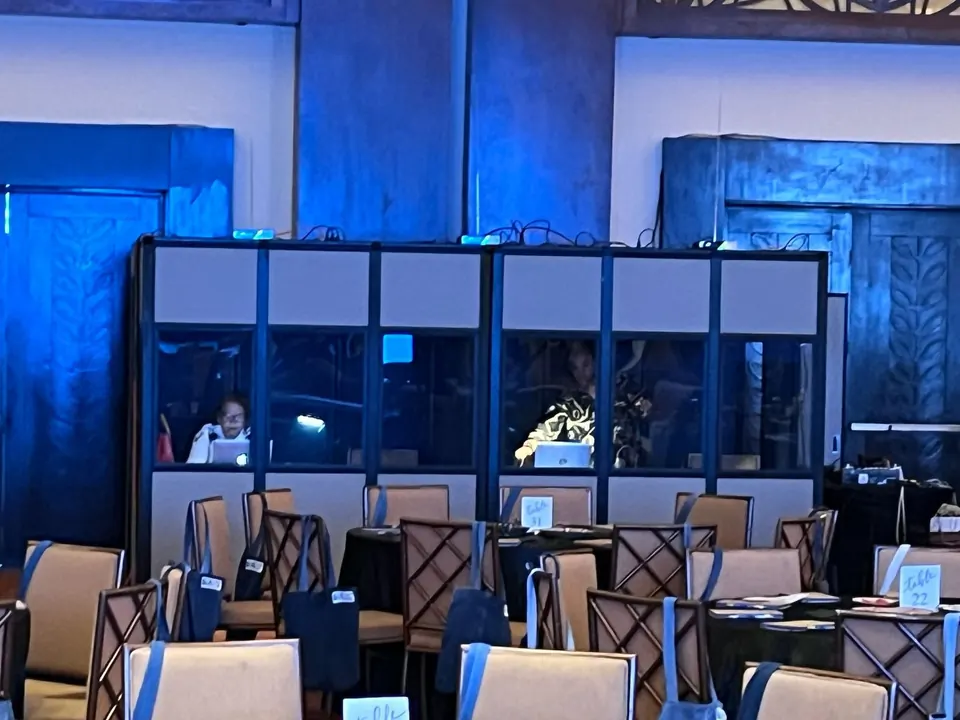
When a conference has speakers and attendees who don't share a language, simultaneous interpretation is what lets everyone follow the event in real time. It takes two things: good interpreters, and a technical system that gives them clean audio and carries their voice, without dropouts, to every attendee's headphones. This guide explains what equipment is used, which technology suits each room and how to plan a bilingual or multilingual event in Panama.
What is simultaneous interpretation and when do you need it?
In simultaneous interpretation, the interpreter listens to the speaker on headphones inside a soundproof booth and speaks at the same time in the other language. The audience picks their language channel on a receiver. It is used at international congresses, medical and pharmaceutical conferences, meetings of multilateral organizations, regional corporate assemblies and any event where stopping the speaker to translate (consecutive interpretation) would stretch the agenda too far.
The equipment in a simultaneous interpretation system
1. Interpretation booths
The interpreters' workspace: soundproofed, ventilated, lit and with a direct view of the stage and screen. The reference international standards are ISO 4043 for mobile booths (the kind set up in a hotel ballroom) and ISO 2603 for permanent booths built into a venue. Both aim at the same thing: sound insulation in both directions, a clear view of the speakers and an environment where interpreters can concentrate for hours.
2. Interpreter consoles
Each interpreter has a console with a microphone, headphones and controls to choose the output channel and mute when coughing or handing over to their partner. The requirements for this equipment are set out in ISO 20109.
3. Audio and video to the booth
An interpreter can only interpret what they hear. So the signal from the room's mixing console (every stage and audience microphone, plus video audio) is sent clean to the booths, and if the booth has a poor view of the speaker or the slides, a video monitor is added. ISO 20108 covers exactly this: the quality of the sound and image delivered to interpreters. This is where a good event audio provider makes the difference.
4. Transmitter
It carries each language channel from the consoles to the audience, by radio frequency (FM) or by infrared; infrared also needs radiators placed around the room (see the table below).
5. Receivers and headphones
Every attendee who needs interpretation gets a receiver with a channel selector, volume control and headphones. They are handed out at registration and collected at the end, so plan a dedicated desk for it.
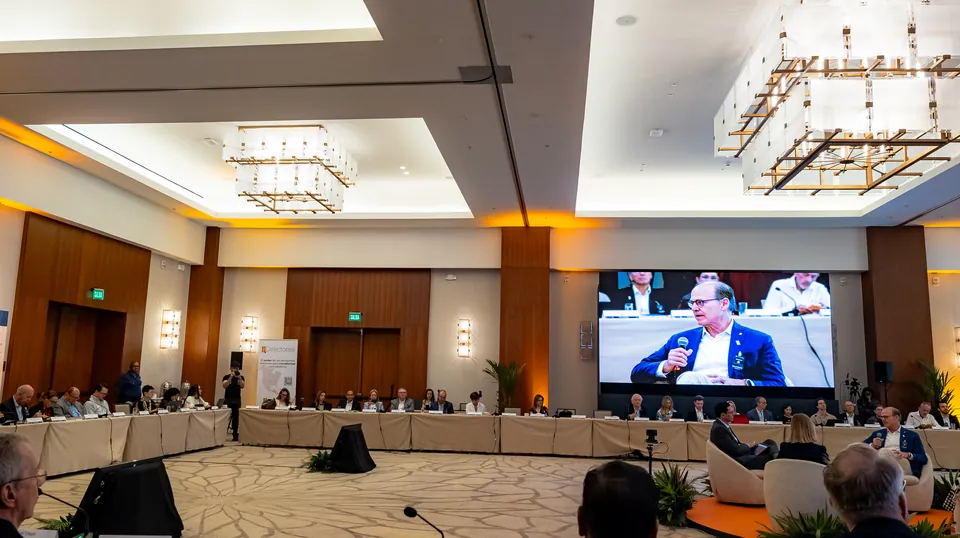
Radio frequency (FM) or infrared (IR): what changes
Both technologies carry the interpreters' audio to the receivers; the difference is how the signal travels and what that means for the setup. At 3S we work mainly with FM systems.
| Radio frequency (FM) | Infrared (IR) | |
|---|---|---|
| How the signal travels | By radio waves, like a radio station: it covers the room with no line of sight needed. | By infrared light: it needs line of sight between the radiators and every receiver. |
| Setup | One transmitter connected to the console; nothing to mount on walls or ceilings. | Radiators placed around the room to cover every table. |
| Daylight and outdoors | Works the same in daylight, in rooms with windows and outdoors. | Direct sunlight affects the signal; used indoors. |
| Mobility | Works for events across several rooms, tours and plant visits. | The signal stays inside the room where the radiators are. |
| Typical use | Hotel congresses and conferences, multi-room events, outdoor events and tours. | Fixed rooms, such as parliaments or boardrooms built with the system. |
How to plan interpretation for your event
- Define the languages and who needs them. Each language combination is one channel and one team of interpreters. Estimate how many attendees will use a receiver.
- Reserve space for the booths. They usually go at the back of the room with a direct view of the stage. Ask the venue for that space from the start, because it affects the table layout.
- Send material to the interpreters in advance. Presentations, agenda, speaker names, acronyms and technical terms. At medical or financial conferences this is what sets the quality of the interpretation.
- Test the channels before doors open. Booth by booth, receiver in hand, from different points in the room.
- Integrate interpretation with the rest of the production. Audience Q&A microphones, videos with audio and the live stream must also reach the booths and, if there is a remote audience, go out in every language.
Remote interpretation: one more option
Remote interpretation platforms let interpreters work from outside the room and the audience listen on their own phones. They can help when there is no space for booths or the language is uncommon in Panama. In exchange, they depend on the quality of the internet connection, so for an in-person conference it is worth reviewing with your provider which combination is safest.
Simultaneous interpretation in Panama with 3S Audiovisuales
3S Audiovisuales e Interpretación coordinates booths, receivers, transmitters and interpreters for international congresses and conferences in Panama, integrated with the event's audio, screens and streaming. We have produced events since 2010 with a technical team that has more than 20 years of experience; together with our sister company Audico Panama we have produced more than 13,000 events. See the service at simultaneous interpretation in Panama or read how it pairs with LED screens for conferences.
References
- DIN EN ISO 2603 — Simultaneous interpreting: permanent booths, requirements
- DIN EN ISO 4043 — Simultaneous interpreting: mobile booths, requirements (series with ISO 20108 and ISO 20109)
- Trusted Translations — Simultaneous interpretation equipment: FM/RF and IR systems